Frequently Asked Questions
-
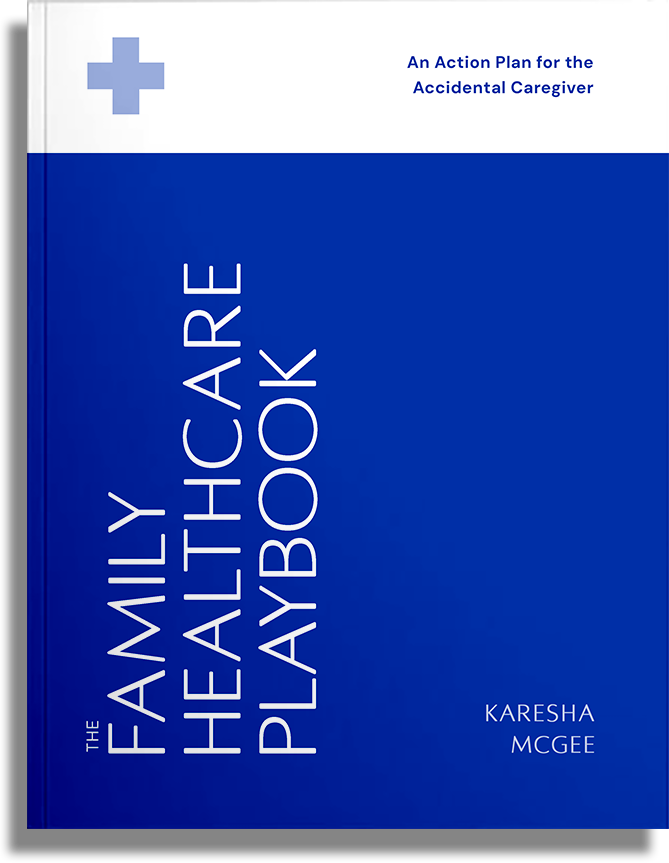
The Family Healthcare Playbook: An Action Plan for the Accidental Caregiver is an actual playbook—an action plan—born out of a life-changing medical crisis I experienced with my mom. This playbook is designed to help you and your loved ones prepare for a future medical issue or manage one if you’re already in it. It aims to help you navigate your new role as a caregiver before, during, and after a medical event. The Family Healthcare Playbook is written for anyone who may unexpectedly find themselves caring for a loved one, such as a parent, grandparent, sibling, child, aunt, cousin, friend, or neighbor. The resources and tools included in this playbook are appropriate for caregiving for anyone at any age.
-
Whether you are just embarking on a caregiving journey or deep in the middle of one, this book is for you. This book includes:
Best practices, lessons learned, and advice to help you and your loved ones prepare for a future medical issue or manage if you’re already in one.
Preparation strategies, laying the legal and medical groundwork for your family’s response to a medical crisis, including an overview of advance directives for healthcare and finances.
Family conversation starters designed to help you navigate your caregiving journey and have the hard family discussions before a crisis hits.
Helpful worksheets for you and your loved ones to complete, along with links to other online support resources.
Short checklists of action items you can begin working on today! The items are organized by time, with recommendations on how to get started, whether you have 5-10 minutes, 15-20 minutes, 1 hour, or a few days to work on this.
-
Accidental caregiving has become an epidemic in the United States.
A landmark 2025 report spearheaded by AARP and the National Alliance for Caregiving, exposes that “roughly one in four American adults is a family caregiver.... [S]ixty-three million adults provide ongoing care for aging parents, spouses with chronic conditions, or adult children with disabilities and serious illnesses—a staggering 45 percent increase since 2015.”*
Those numbers are expected to accelerate dramatically in the coming years due to a steadily aging population, post-COVID-19 healthcare needs, and increasing demands for home healthcare services.
Unpaid caregiving is a tremendous economic drain on our society. A 2023 report from the AARP Public Policy Institute estimated the economic value of family caregiving was $600 billion in 2021, a dramatic increase from a similar report using 2017 data that estimated the value at $470 billion.** Given the rise from 2017 to 2021, it’s probable that the economic drain has only increased as the number of unpaid caregivers has also increased.
While resources, programs, and infrastructure exist for professional caregivers, accidental caregivers are often left to fend for themselves… until now.
*Statistics from AARP and the National Alliance for Caregiving, “Caregiving in the US 2025,” July 24, 2025, https://doi.org/10.26419/ppi.00373.001.
**Statistics from Susan C. Reinhard, Selena Caldera, Ari Houser, and Rita B. Choula, “Valuing the Invaluable: Strengthening Supports for Family Caregivers, 2023 Update,” AARP Public Policy Institute, March 2023, https://doi.org/10.26419/ ppi.00082.006.
-
While writing this book, I’ve often been asked: You come from tech, so why not an app instead of a book? What about building an AI Agent?
In the case of GenAI, AI agents, and apps, I’ve found it most helpful to have a yes and approach to caregiving. Yes, I am all for using technology to help address some of the challenges and opportunities associated with caregiving. Technology can augment some of the work of a caregiver, such as using AI tools for note-taking during a doctor’s appointment or to review trends in blood pressure readings over time. In fact, early research and reports suggest that AI may become a highly beneficial tool for medical professionals and caregivers alike.
With all this in mind, I started with a playbook that includes words of advice, resources, and worksheets that are simple and perhaps surprisingly low-tech by design. Why? Because caregiving starts and ends with the person— your loved one, the patient. Despite technology interventions, all medical issues involve people and the complexities, emotions, neurosis, and stressors of being human. Yes, there are many ways to optimize and enable caregiving with technology, such as telemedicine, diagnostic testing, online repositories, querying large language models (LLMs) for healthcare advice. Still, when your loved one is in the intensive care unit (ICU) or you’re suddenly faced with a life-or-death decision, a lot of that technology goes out the window.
The bottom line is that technology can absolutely help, and in the future, I believe technology can bring some of the tools and resources in this book to life. At the same time, caregiving and all the emotions associated with it will always require a human touch.
-
I am available for the following:
Speaking engagements on topics including caregiving, juggling work while caregiving, leadership, and storytelling.
Employee education on caregiving.
Consultations on the development of employee resources for family caregiving.
Serving as a patient and family advisor in partnership with a hospital or healthcare system.
Guest lecturing in relevant university programs, including nursing, social work, gerontology, human development, and family studies.
-
If you would like to contact me or receive updates from The Family Healthcare Playbook, please:
Email me at karesha@TheFamilyHealthcarePlaybook.com.
Reach out using the contact form at TheFamilyHealthcarePlaybook.com.
Message me on LinkedIn at https://linkedin.com/in/kareshamcgee.
-
Yes! This playbook is a living project, and I will update the materials on TheFamilyHealthcarePlaybook.com website as healthcare guidelines and laws change and as I learn more about this important subject. Additionally, a Spanish translation of this book is on the horizon, with plans to consider additional languages in the future. One of my goals is to ignite a global conversation about the need for better support, resources, and infrastructure for accidental caregivers. There are millions of accidental caregivers around the world, and I want to help as many as possible. Remember, you don’t have to do this caregiving thing alone. We’re all in it together.